
Probably one of my favorite periods of jet design is the early Cold War period. Not only was every branch trying to make sure they kept a piece of the nuclear delivery pie,resulting in the navy having subs capable of launching nuclear cruise/ballistic missiles AND carrier-launched bombers jerry-rigged to drop nuclear payloads, the Air Force controlling ballistic missile systems and strategic bombers, and the Army being left with, uh, I guess nuclear artillery that would par-boil its users, but produced some hilariously impractical designs that were forced into new roles as the strategic situation with the Soviet Union changed. My first beloved example is the B-58 Hustler.
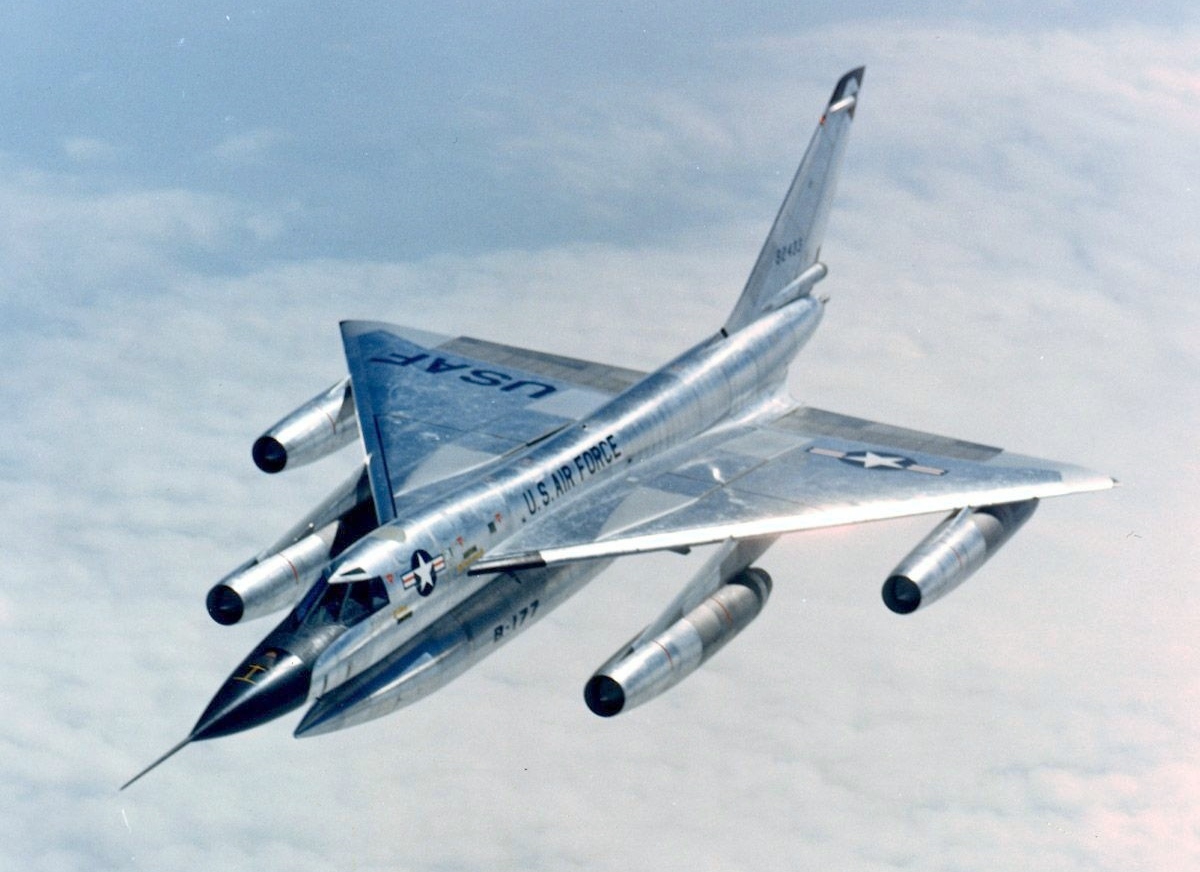
For me, the B-58 was always this bizarre flipper-baby mach-2 strategic bomber that in many ways represented the bleeding edge of Cold War jet design, that wonderful period between 1945 and 1960 before things like computer aided design and common sense smashed the “weirdness” out of what amounted to drawings on gin soaked cocktail napkins from a bar down the street from General Dynamics. The first truly supersonic jet bomber, the B-58 was designed to fly high and fast, avoiding Soviet fighters, and then drop up to five nuclear bombs before running for home. The reality was… less than impressive.

With its first flight in 1956, the complicated B-58 proved to be a maintenance queen, costing significantly more per flight hour than the venerable B-52 (which will likely remain in service for another few decades). Furthermore, it had a shorter range and smaller payload than the B-52, with the added benefits of having a smaller, overworked crew of three managing a notoriously difficult to handle air-frame. In other words, despite the aesthetics, the B-58 proved to be problematic compared to its sibling. The nail in the coffin proved to come from Soviet advances in air defense: Accurate, high-altitude surface-to-air-missile systems like the ones that shot down Francis Gary Powers’ U-2 spyplane the same year the B-58 entered service. With the U-2 shootdown, the B-58 was reassigned to low-level penetration strikes where its engines underperformed, resulting in its retirement from service in 1970.
Personally, my favorite story to come out of the B-58 program was the difficulties faced by engineers as they tried to design a way for the crew to eject from the craft without being immediately killed or injured by the shock. The solution was separate escape capsules that enclosed each crew member. In what I can only assume to be a fever-dream fueled by a cocktail lunch, engineers designing the capsule tested them by sticking an anesthetized bear into the capsule and ejecting them from an airborne test craft. I can only imagine the guys running the test drew straws to see who had to pull the drugged and probably furious bear out of the capsule.

For me, the B-58 program neatly encapsulates the key planning problem facing military jet design during this period: The assumption that the Soviets were years behind in air defense systems produced a series of bombers that were obsolete almost as soon as they were introduced, and were hurriedly crammed into new roles at odds with their original performance envelope. Luckily, the B-58 just wasted money and didn’t get anyone killed. Designs like the F-105 Thunderchief (article forthcoming) however put pilots in the line of fire in Vietnam doing a job for which the plane was never intended.
 Le Grognard