
In the popular imagination any mention of the French Revolution inevitably conjures up images of crowds storming the Bastille, innocents awaiting the guillotine, soon followed by Napoleon Bonaparte astride a wild-eyed charger dominating the Alps themselves. While certainly a romantic image, and one that has proved lucrative for playwrights and painters, the general view of the French Revolution has a marked tendency to gloss over a core conflict inherent to the very nature of successive revolutionary governments[1]: popular resistance in the countryside to the dictates of the Parisian government. In the Vendée we can see the clash of revolutionary values with the profound religiosity of the French peasantry, and the consequences of a hardline counter-insurgency policy focused on body counts over effective pacification.
The particularly intractable insurgency in the department of the Vendée has been called “perhaps the first, and certainly one of the earliest, of the modern ideological insurgencies”[2] that, while ultimately subdued, acted as a bloody dress rehearsal for counter-insurgency tactics employed, for better or for worse, in more well-publicized conflicts like Napoleon’s occupation of Spain.[3] Unlike the guerilla war in the Spanish countryside the Vendée rebellion amounted to a civil war, with all the attendant savagery amplified by the all-or-nothing ideological divide between the two belligerents. For the Republicans, the backwards priest-ridden peasants were “a people so strangely blinded and so bizarrely misled that they took up arms against the Revolution, their mother, against the security of the people, against themselves.”[4] In contrast, the insurgents viewed themselves as fighting to defend their liberties and traditions against an overbearing and distant central government that had killed their king, taken their young men to fight on the eastern frontiers (the sons of Republican officials always found exemptions), and tried to replace their parish priests with heretics who knew nothing about their daily struggles. The collision of these two competing worldviews created an atmosphere where both sides recognized the other only as traitors no longer subject to the rules of war. Furthermore, the nature of fighting in the bocage country guaranteed that any fighting would consist of short, sharp ambushes and skirmishes: la petite guerre at its worst.

It was the tone-deafness of the representatives of the First Republic that caused the major rebellions in the west of France in the Spring of 1793, and their refusal to countenance any legitimate challenge to their sovereignty as the embodiment of la Patrie which turned swathes of the countryside into a no-mans’-land for anyone wearing the Revolutionary cockade. Adding to this sense of crisis was the collapse of the French war effort along the eastern frontier, where the Duke of Brunswick’s army positioned like a dagger at the heart of the Republic in Paris. Torn between two crises, the Republican government “trying to douse several fires at once, starved the Vendée of troops, and those they did provide were all too often ill-trained volunteers who tended to desert and to panic under fire,”[5] led by newly promoted officers selected for their political connections rather than battlefield experience. The success of the insurgent Catholic and Royal Army, therefore, was due to the inability of various levels of the local command structure to cooperate[6] and a shocking lack of supplies that created an unruly and starving command. The end result on the ground was a soldiery prone to violence against the local population, regardless if they were sympathetic to the insurgents, thus depriving Republican forces of desperately needed local intelligence.

Despite a few stunning victories against isolated Republican columns, the Vendéans were unable to solidify their position as an insurgent force. By Fall 1793 the situation in the East had stabilized, allowing the transfer of seasoned troops to the region. Crucially, with the arrival of the harvest, many peasants were obliged to desert the Royal and Catholic Army to tend to their crops, accelerating the rate of attrition for the insurgents. Soon, the insurgents found themselves beneath the critical mass necessary to maintain conventional military operations, and after a decisive clash at Cholet that isolated the Vendée insurgents from the possibility of British support, in the coming weeks would more closely resemble a camp of refugees[7] than an army on the move. By the winter of 1793-1794, General Westermann wrote to his superiors in Paris, in typically overheated rhetoric that “There is no more Vendée, citizens. […] I have crushed children under the hooves of horses, and massacred women who, these at least, will give birth to no more brigands. I do not have a single prisoner with which to reproach myself. I have exterminated everyone.”[8] While conventional military operations ended by the end of 1793, suppression of what Republicans called “brigands” would take the lives of many more civilians and belligerents.

It is worth stressing Westermann’s reference to the insurgents as “brigands” here, as it is strongly indicative of how Revolutionary authorities viewed insurgents: at once anti-revolutionary as well as anti-social, a threat not just to the Republic but to the social fabric at large, and thus exempt from protections conferred even to enemy soldiers.[9] Incessant rhetoric like this enabled horrific crimes to be perpetrated on the local citizenry with an unnerving level of innovation.[10] To carry out the Parisian government’s scorched earth policy a number of colonnes infernales were unleashed on the rebellious region, burning farms and villages, and summarily executing suspected rebels. This rhetoric combined with the inexperience of both officers and men under Republican arms resulted in many generals linking the progress of pacification with high body counts.[11] The brutal treatment of civilians by Republican soldiers, instead of breaking the will of insurgents, only perpetuated a seemingly endless cycle of atrocity and counter-atrocity with no end in sight.
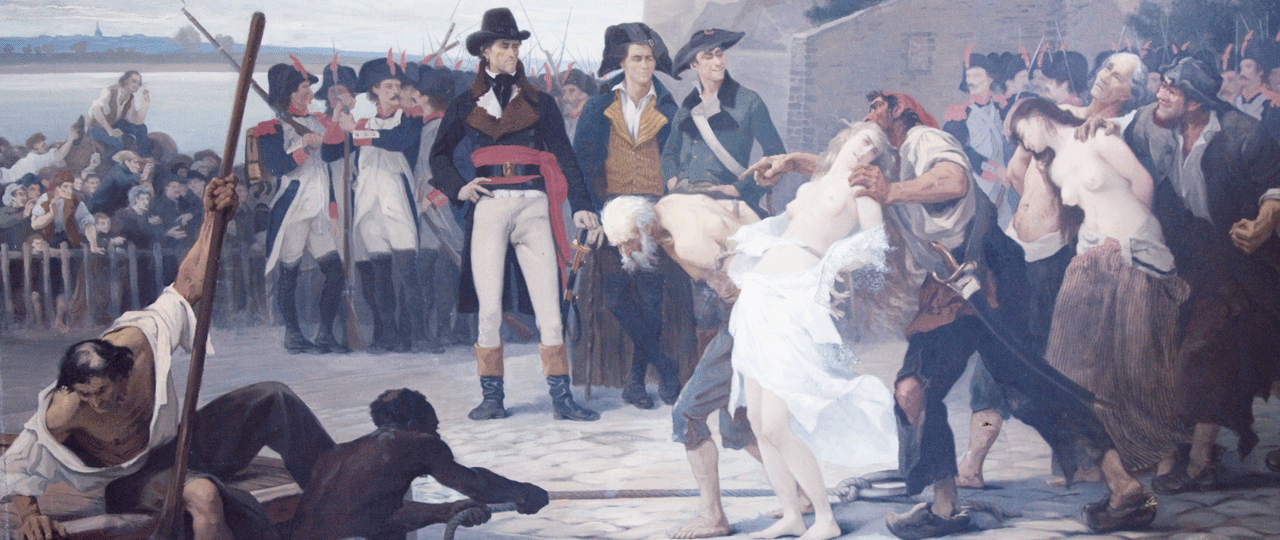
Strangely, the salvation of the region laid with moderates in Paris when they overthrew radical Jacobins who had screamed for the eradication of the Vendée in its entirety. The perpetrators of the worst excesses of the “pacification” went to the guillotine alongside most of their political masters.[12] The Thermidorian Reaction of 27 July 1794 marked a decisive turning point in French counter-insurgency policy: The radicals led by Robespierre were replaced by moderates, just as concerned about saving their own skins from the guillotine as they were maintaining law and order in the countryside. They set about replacing the worst “Terrorist” officials in many rural departments, releasing thousands of peasants arrested originally under “generous” interpretations of the Law of Suspects, and most importantly offered a general amnesty in December 1794. In place of the ineffective colonnes infernales, newly appointed general Louis-Lazare Hoche constructed strongpoints across the rebellious departments, linked by heavy patrols that disrupted communications between various insurgent groups combined with a naval blockade to prevent foreign aid from being floated ashore. With each new line of blockhouses, he forced the rebels out of their bocage hideouts towards the coast, enacting an early form of clear-and-hold that would dominate counter-insurgency tactics in the twentieth century.[13] Instead of eradicating the populace, Hoche systematically disarmed the region parish by parish, insisting that, in stark contrast to the sanguinary rhetoric employed by his predecessors, “the enemy is not the Vendée, the only enemy was England.”[14] Surprisingly, Hoche went so far as to suggest that freedom of worship, the spark that had ignited the conflagration in the first place, be a central part of the final treaty between the peasant insurgents and the Republican government in February 1795. Having systematically deprived the rebels of the impetus to revolt (there were further amnesties and draft exceptions as well) as well as the physical means to do so by disarmament programs, and smothering the region with thousands of disciplined troops, Hoche broke the back of simmering insurgency in the Vendée. By taking a conciliatory approach in favor of the blood-curdling demands made by radical Republicans and their appointed generals, the exhausted populace submitted to limited Republican rule.
While popular revolts within the French Republic (and later the Empire) would flare up, none would reach the intensity of the rebellion in the Vendée. When placed into its historical context, the rebellion itself was not an existential threat to the Republic, but taken with military setbacks against the coalition arrayed against the First Republic and other major rebellions elsewhere, it does serve as a valuable case study on the limitations of insurgencies in the early modern period. The region lost up to a third of its total population during the rebellion, with most historians agreeing on around 150,000 dead of all causes on both sides, more than the total number of Frenchmen that had died during Napoleon’s disastrous Russian campaign.[15] However, the “soft” approach to counter-insurgency would linger in French domestic policy: no more mass executions, no more demands for total annihilation of French citizens. In the aftermath of later uprisings, rebels and suspected rebels were arrested and tried, rather than summarily executed.[16] As a matter of policy, extrajudicial means were to be limited as much as possible and the rule of law restored after years of Revolutionary upheaval. By escaping the Terror, moderate Republicans hoped they would be able to cement the legitimacy of the First Republic government in the minds of the governed. Unfortunately, the same cannot be said for the experience of the Spanish under occupation by the forces of Napoleon Bonaparte just a few years later.
Works Consulted
Bell, David A. The First Total War. New York: Houghton Mifflin, 2007.
Brown, Howard G. Ending the French Revolution: Violence, Justice and Repression from the Terror to Napoleon. Charlottesville: University of Virginia Press, 2006.
Doyle, William. The French Revolution: A Very Short Introduction. New York: Oxford University Press, 2001.
Forrest, Alan. “The Insurgency of the Vendée.” Small Wars and Insurgencies (Taylor & Francis Group) 25, no. 4 (2014): 800-813.
Joes, Anthony James. “Insurgency and Genocide: La Vendée.” Small Wars & Insurgencies (Taylor & Francis Group) 9, no. 3 (1998): 18-45.
Secher, Reynald. A French Genocide: The Vendée. Notre Dame: University of Notre Dame Press, 1986.
[1] In the interest of simplicity, I will refer to the various governments that ruled France following 1789 until 1804 (National Constituent Assembly, Legislative Assembly, National Assembly [including the Committee of Public Safety], the Directory, and the Consulate, respectively) as the First Republic.
[2]Anthony James Joes, “Insurgency and Genocide: La Vendée”. Small Wars & Insurgencies, volume 9, issue 3: 17.
[3] Reynald Secher’s A French Genocide: The Vendée alleges that the suppression of the revolt in the Vendée was a forerunner to the Nazi SS, Stalin’s Gulag, and Khmer Rouge’s killing fields in its ferocity as well as its systematic eradication of a suspect population. The larger academic community, however, has largely discredited his findings.
[4] Alan Forrest, “The Insurgency of the Vendée,” Small Wars & Insurgencies, vol 25, issue 4: 800.
[5] Bell, The First Total War, 168.
[6] Even more so when deputies from the Republican government were hovering around them, eager to root out anything resembling “moderation” in the face of an existential threat to the Republic. Furthermore, the purging of the officer corps by radical Revolutionaries after 1789 led to the loss of personnel well versed in unconventional warfare in the Americas. Ironically, this loss of colonially experienced officers and men meant that the Vendée experience would be the milestone by which other unconventional conflicts would be judged in the French army.
[7] By this stage in the revolt, the families of the insurgents joined in with the rebel columns, as they knew they had no protection from vengeful Republican soldiers.
[8] Bell, The First Total War, 170-173.
[9] Forrest, “Vendée,” 803.
[10] The most famous of these excesses occurred in Nantes, where captured insurgents and priests were boarded up into barges in the Loire River, which were then sunk in order to drown the occupants. Afterwards, these barges were raised, and the next batch were loaded in and sunk ad nauseam. Accounts vary, but reliable estimates place the number drowned in Nantes between 2,800 and 4,600. Debates also occurred in the National Convention regarding the feasibility of poison gas and the placement of poisoned barrels of brandy in the region.
[11] Bell, The First Total War, 177.
[12] Many of the moderates of the Thermidorian Reaction found convenient scapegoats in men like Jean-Baptiste Carrier, the man responsible for the mass drownings in Nantes.
[13] Joes, “Vendée and Genocide,” 33.
[14] Joes, “Vendée and Genocide,” 33-34.
[15] Joes, “Vendée and Genocide,” 37.
[16] Strangely enough, military tribunals were found to be less likely to execute a defendant than their local civil counterparts, being separated from local political divides that had rendered some areas of France without effective government. See also: Howard G. Brown, Ending the Revolution: Violence, Justice and Repression from the Terror to Napoleon.
 Le Grognard