
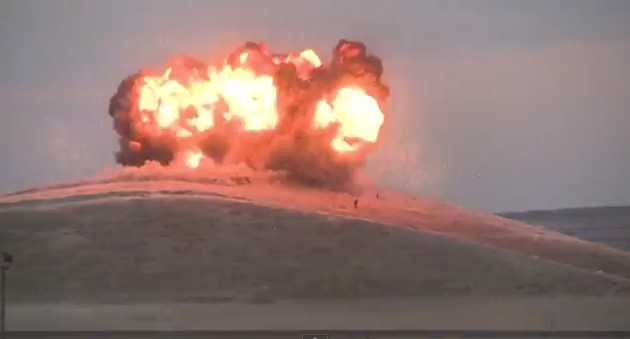
To describe it as a media oriented operation would be an understatement. When the Islamic State raised a flag on the Syrian-Turkish border near Kobane it represented a propaganda coup for ISIS, a clear message of dominance to Syrian refugees just across the border in Turkey. From a tactical standpoint, it was a non-issue, as the outpost consisted of a handful of fighters with small arms around a makeshift flagpole, but on October 23, 2014 the USAF responded with an overwhelming show of force, obliterating the outpost with thousands of pounds of bombs to cheers on the Turkish side of the border.[1] This spectacular overkill resonated with Western audiences[2]: air strikes (referred to as kinetic action) could allow the US to attack ISIS without direct involvement of ground troops. This belief in the decisiveness of air strikes have largely overshadowed the equally vital elements of air power, those of surveillance and mobility. Playing the long-game in counterinsurgency is significantly more important than weekly highlight reels of air strikes, but runs at odds with a political culture that expects immediate kinetic results.
The belief that kinetic airpower has the ability to cheaply and easily defeat insurgencies has a pedigree as old as airpower itself. During the period between the World Wars, British experiments with “aerial policing” in its far flung colonial holdings produced mixed results on the ground and over-heated rhetoric amongst staff officers seeking to justify the continued existence of an independent air arm. For example, in place of the old colonial policy of dispatching a punitive expedition by foot to “pacify” hostile tribes, men like Air Marshal Hugh Trenchard enacted a policy of “air control” whereby uncooperative tribes would be punished from the air by bombing attacks. For an administration as cash strapped as the War Office in the interwar years, the possibility that “within 45 minutes a full-sized village… can be practically wiped out and a third of its inhabitants killed or injured by four or five planes which offer them no real target and no opportunity for glory,”[3] seemed a tantalizing proposition, and with a £750,000 savings from the budget in Iraq, air-policing was extended to elsewhere in the British empire.[4] In reality, the ineffectiveness of air-policing taken without close cooperation with ground troops went unnoticed by most officer-academics, who opted for a rose-tinted view that justified their branch of service.
In contrast to the growing public perception of the usefulness of kinetic airpower after the Second World War, the Royal Air Force’s actions during the Malay Emergency (1948-1960) demonstrated the non-kinetic values of airpower in the form of air mobility, resupply, reconnaissance and psychological operations all in cooperation with ground forces.[5] According to one RAF officer, non-kinetic airpower tasks “combined to multiply the number of troops and police deployed on productive jungle patrols by a factor of not less than four.”[6] While less cathartic than videos of bombing runs, the employment of airpower as a force multiplier to isolate insurgents from the general population and rob them of initiative. Combined with a patient political program, the British were able to neutralize Communist forces on the Malay peninsula and produce what is widely regarded as the gold standard for counterinsurgency operations.
Public perceptions of the effectiveness of air strikes reached a fever pitch after the experiences of the 1991 Gulf War. Precision guided munitions combined with global news networks produced a culture of highlight reels of bombs being guided straight into windows from miles away. While the conventional effectiveness of precision munitions is clear, their usefulness in counterinsurgency operations is questionable. Videos of laser and GPS guided munitions striking targets in Iraq and Afghanistan are widespread, and the wider public equates these strikes with counterinsurgency, expecting immediate results.
This has leaked into American political rhetoric, as one only needs to look at how promises by former presidential candidate Ted Cruz’s promise to bomb Raqqa flat strike such a chord amongst the American electorate that for the past two decades have been conditioned to expect immediate and spectacular outcomes. Even the most hawkish politicians are loath to deploy ground troops into the Middle East, expecting the full weight of the USAF to overwhelm ISIS.[7] With this experience in mind, the B-1 strike near Kobane becomes as much an act of support to the Turkish government as it is to the American people.
But is this a useful approach? According to one French general on the USAF doctrine in Vietnam: “First, it has been confirmed once again that air power, when it is armed only with classical bombs, has not the strength that too many theorists grant it… [Moreover], the airplane needs ‘paying’ objectives which guerrilla warfare hardly affords.”[8] These objectives do not just “pay” in the military sense, but in the public’s perception of the strike as well. Splashy operations like the Kobane strike demonstrate as explicitly as possible to the greater public that the government is taking the fight to ISIS in an effective way, but may lead to a lack of appreciation for airpower’s non-kinetic effects. Simply the presence of aircraft can significantly hamper insurgent activities with the threat of observation and retaliation, and the employment of unmanned drones can provide nearly 24/7 areas of observation. In essence, the unglamorous work in the air when undertaken with proper support on the ground, prove to be a decisive element in counterinsurgency action.
In sum, the deployment of kinetic force can be a double edged sword, it can act as a tool to demonstrate the potency of a government fighting an insurgency to its domestic base on one hand, and fostering the politically difficult expectation of immediate victory on the other. This can form a post-modern normative gap, where the public perception of what is being done to fight a group like ISIS is one of ineffectiveness and demands actions counter to the basic precepts of counter-insurgency operations. In other words, shows of force by the US military can simultaneously demonstrate its potency and its weaknesses. Experience has shown that even with an overwhelming air presence, if the political and civil elements of a counterinsurgency effort are not there, the military effort is a castle built on sand. A cultural shift, not just within the USAF but with the expectations of a country combating insurgencies needs to realign with reality.
[1] It should be no coincidence that the incident was caught on a high definition video camera and posted online later that day.
[2] Note, considering the scope of this paper, the term “public” is largely intended to represent the general political rhetoric around the issue of ISIS, and is largely impressionistic.
[3] James S. Corum and Wray R. Johnson, Airpower in Small Wars : Fighting Insurgents and Terrorists, Modern War Studies (Lawrence, Kan.: University Press of Kansas, 2003), 42-44.
[4] Peter Paret, Gordon Alexander Craig, and Felix Gilbert, Makers of Modern Strategy : From Machiavelli to the Nuclear Age, Princeton Paperbacks (Princeton, N.J.: Princeton University Press, 1986), 632-33.
[5] Corum and Johnson, 191; Andrew Mumford, “Unnecessary or Unsung? The Utilisation of Airpower in Britain’s Colonial Counterinsurgencies,” Small Wars & Insurgencies 20, no. 3-4 (2009): 601.
[6] Corum and Johnson, 195.
[7] See also, this op-ed piece: https://ijr.com/opinion/2015/11/250238-what-defeating-isis-would-look-like/
[8] Corum and Johnson, 268.
Bibliography
Baltrusaitis, Daniel. “Airpower: The Flip Side of Coin.” Georgetown Journal of International Affairs 9, no. 2 (2008): 89-96.
Corum, James S., and Wray R. Johnson. Airpower in Small Wars : Fighting Insurgents and Terrorists. Modern War Studies. Lawrence, Kan.: University Press of Kansas, 2003.
Mumford, Andrew. “Unnecessary or Unsung? The Utilisation of Airpower in Britain’s Colonial Counterinsurgencies.” Small Wars & Insurgencies 20, no. 3-4 (2009): 636-55.
Pape, Robert Anthony. Bombing to Win : Air Power and Coercion in War. Cornell Studies in Security Affairs. Ithaca, N.Y.: Cornell University Press, 1996.
Paret, Peter, Gordon Alexander Craig, and Felix Gilbert. Makers of Modern Strategy : From Machiavelli to the Nuclear Age. Princeton Paperbacks. Princeton, N.J.: Princeton University Press, 1986.
Read, Derek. “Airpower in Coin: Can Airpower Make a Significant Contribution to Counter‐Insurgency?”. Defence Studies 10, no. 1-2 (2010): 126-51.
 Le Grognard